astronomy-js
AstronomyJS


Astronomical calculations in JavaScript.
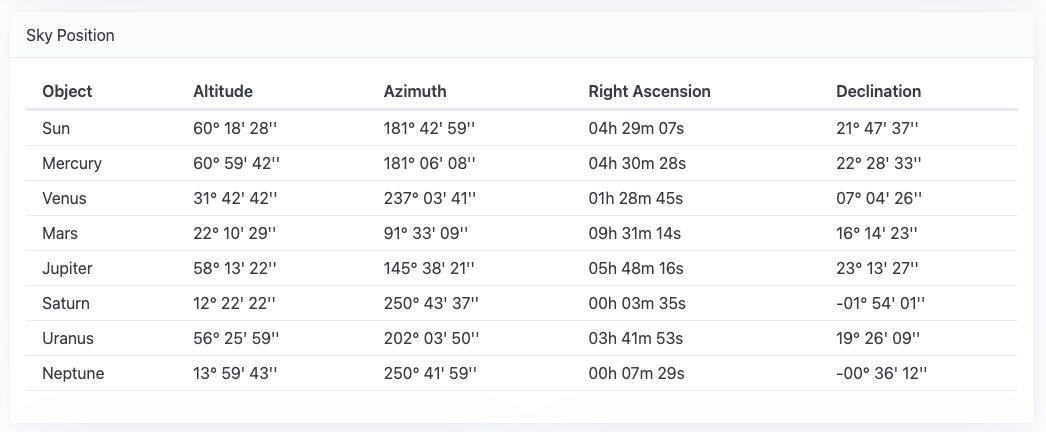
🚀 See It in Action!
These tiles were generated using the astronomy-svg library.
👉 Check out the live demo here
📖 API Reference
AstronomyJS
The main class to interact with the library.
Static Methods
initialize(latitude, longitude)- Initializes a new
AstronomyJSinstance with the given coordinates on Earth. - Parameters:
latitude(number): Latitude in degrees.longitude(number): Longitude in degrees.
- Returns:
AstronomyJSinstance. - Example:
const astronomy = AstronomyJS.initialize(52.52, 13.405);
// Returns: AstronomyJS { ... }
- Initializes a new
Instance Methods
setDate(date)- Sets the simulation date.
- Parameters:
date(Date object): The new simulation date.
- Example:
astronomy.setDate(new Date("2024-03-20T12:00:00Z"));
getDate()- Returns the current simulation date.
- Returns: The current simulation
Dateobject. - Example:
const date = astronomy.getDate();
// Returns: 2024-03-20T12:00:00.000Z
setJulianDate(julianDate)- Sets the simulation date using Julian Date.
- Parameters:
julianDate(number): The new Julian Date.
- Example:
astronomy.setJulianDate(2460389.5);
getJulianDate()- Returns the current Julian Date.
- Returns: The current Julian Date (number).
- Example:
const julianDate = astronomy.getJulianDate();
// Returns: 2460389.5
setLocation(objectName, latitude, longitude, elevation)- Sets the observer’s location.
- Parameters:
objectName(string): Name of the solar system body (e.g., “Earth”).latitude(number): Latitude in degrees.longitude(number): Longitude in degrees.elevation(number): Elevation from surface in meters.
- Example:
astronomy.setLocation("Earth", 48.8566, 2.3522, 35);
getAltitudeAzimuthCoordinatesForObject(objectName, [referenceDate])- Calculates Altitude and Azimuth for a given object.
- Parameters:
objectName(string): Name of the object (e.g., “Sun”, “Moon”, “Mars”).referenceDate(Date, optional): Overrides the instance date.
- Returns: Object with
azimuth,altitude, anddistance. - Example:
const coordinates = astronomy.getAltitudeAzimuthCoordinatesForObject("Sun");
/*
Returns:
{
  "azimuth": 185.23,
  "altitude": 42.15,
  "distance": 0.9958,
  "observerLocation": { ... }
}
*/
getRightAscensionDeclinationCoordinatesForObject(objectName, [referenceDate])- Calculates Right Ascension and Declination.
- Parameters:
objectName(string): Name of the object (e.g., “Sun”).referenceDate(Date, optional): Overrides the instance date.
- Returns: Object with
rightAscension,declination, anddistance. - Example:
const coordinates = astronomy.getRightAscensionDeclinationCoordinatesForObject("Sun");
/*
Returns:
{
  "rightAscension": 358.12,
  "declination": -1.25,
  "distance": 0.9958,
  "observerLocation": { ... }
}
*/
getHourAngleDeclinationCoordinatesForObject(objectName, [referenceDate])- Calculates Hour Angle and Declination.
- Parameters:
objectName(string): Name of the object (e.g., “Sun”).referenceDate(Date, optional): Overrides the instance date.
- Returns: Object with
hourAngle,declination, anddistance. - Example:
const coordinates = astronomy.getHourAngleDeclinationCoordinatesForObject("Sun");
/*
Returns:
{
  "hourAngle": 15.45,
  "declination": -1.25,
  "distance": 0.9958
}
*/
getIlluminatedFractionForObject(objectName, [referenceDate])- Calculates the illuminated fraction for light coming from the Sun for a given object.
- Parameters:
objectName(string): Name of the object (e.g., “Moon”).referenceDate(Date, optional): Overrides the instance date.
- Returns: Number between 0 and 1 representing the illuminated fraction.
- Example:
const illuminatedFraction = astronomy.getIlluminatedFractionForObject("Moon");
/*
Returns: 0.253
*/
getNextMoonPhaseDate(phase, [referenceDate])- Calculates the next date when the Moon reaches one of the 8 common phases.
- Parameters:
phase(string): One ofNEW_MOON,WAXING_CRESCENT,FIRST_QUARTER,WAXING_GIBBOUS,FULL_MOON,WANING_GIBBOUS,LAST_QUARTER,WANING_CRESCENT.referenceDate(Date ornull, optional): Overrides the instance date. Usenullor omit it to use the current simulation date.
- Returns:
Date. - Example:
const nextFullMoon = astronomy.getNextMoonPhaseDate("FULL_MOON", null);
// Returns: Date
getPreviousMoonPhaseDate(phase, [referenceDate])- Calculates the previous date when the Moon reached one of the 8 common phases.
- Parameters:
phase(string): One ofNEW_MOON,WAXING_CRESCENT,FIRST_QUARTER,WAXING_GIBBOUS,FULL_MOON,WANING_GIBBOUS,LAST_QUARTER,WANING_CRESCENT.referenceDate(Date ornull, optional): Overrides the instance date. Usenullor omit it to use the current simulation date.
- Returns:
Date. - Example:
const previousNewMoon = astronomy.getPreviousMoonPhaseDate("NEW_MOON", new Date());
// Returns: Date
getEphemerisDateForObject(objectName, referenceDate, ephemerisTypeName)- Finds the date of an ephemeris event (e.g., “Rise”, “Set”).
- Parameters:
objectName(string): e.g., “Sun”.referenceDate(Date): The date to search around.ephemerisTypeName(string): e.g., “SUNRISE”, “SUNSET”, “CIVIL_TWILIGHT_START”.
- Returns:
Dateornull. - Example:
const sunrise = astronomy.getEphemerisDateForObject("Sun", new Date(), "SUNRISE");
// Returns: 2024-03-20T06:15:22.000Z
getLocalMeanSiderealTime()- Returns the Local Mean Sidereal Time in degrees.
- Returns: Local Mean Sidereal Time in degrees (number).
- Example:
const localMeanSiderealTime = astronomy.getLocalMeanSiderealTime();
// Returns: 185.45
getLatitudeLongitudeCoordinates()- Returns the current observer’s latitude and longitude.
- Returns: Object with the current observer’s
latitudeandlongitude. - Example:
const coordinates = astronomy.getLatitudeLongitudeCoordinates();
/*
Returns:
{
  "latitude": 52.52,
  "longitude": 13.405
}
*/
getObserverLocation()- Returns the full observer location details.
- Returns: Full
ObserverLocationobject ornull. - Example:
const location = astronomy.getObserverLocation();
// Returns: ObserverLocation { longitude: 13.405, latitude: 52.52, ... }
getSkyObjectByName(objectName)- Retrieves a sky object’s data by its name.
- Parameters:
objectName(string): Name of the object (e.g., “Jupiter”).
- Returns:
SolarSystemObjectdata ornull. - Example:
const jupiter = astronomy.getSkyObjectByName("Jupiter");
// Returns: Jupiter { name: "Jupiter", ... }
🪐 Supported Objects and Ephemeris Types
The library includes data for major solar system bodies and various ephemeris events.
Common Objects
Sun,Moon- Planets:
Mercury,Venus,Earth,Mars,Jupiter,Saturn,Uranus,Neptune - Dwarf Planets:
Pluto
Ephemeris Types
Use these names with getEphemerisDateForObject:
RISE,SET,SUNRISE,SUNSET,MOONRISE,MOONSETCIVIL_TWILIGHT_START,CIVIL_TWILIGHT_ENDNAUTICAL_TWILIGHT_START,NAUTICAL_TWILIGHT_ENDASTRONOMICAL_TWILIGHT_START,ASTRONOMICAL_TWILIGHT_ENDGOLDEN_HOUR_START,GOLDEN_HOUR_END
🪐 Supported Calculations
- Right Ascension and Declination for celestial body
- Hour Angle and Declination for celestial body
- Altitude and Azimuth for celestial body
- Next and previous Moon phase dates
- Ephemeris for the Sun (astronomical twilight, nautical twilight, civil twilight)
- Ephemeris for celestial body (rise, set)
-
🔭 Includes Pluto!
Quickstart
🌐 Using the Browser-Ready Minified Script
<script type="text/javascript" src="astronomy-js.min.js"></script>
// latitude, longitude
let astronomyJS = AstronomyJS.initialize(56.2, 18.1)
astronomyJS.getAltitudeAzimuthCoordinatesForObject("Sun");
🌟 Installation (npm)
npm install astronomy-js
Using the JavaScript ES Module
import { AstronomyJS } from "astronomy-js";
// latitude, longitude
let astronomyJS = AstronomyJS.initialize(56.2, 18.1)
astronomyJS.getAltitudeAzimuthCoordinatesForObject("Sun");
📄 License
This project is licensed under the MIT License — feel free to use, modify, and share it.
Please make sure to retain the original license and attribution when reusing or modifying the code.
See the LICENSE file for full details.
🌌 About
This library provides astronomical calculations for leisure purposes only. Some important basic aspects are not implemented, such as:
- Atmospheric refraction
- Orbit perturbations

📚 References
US Naval Observatory, Explanatory Supplement to the Astronomical Almanac, 1992